
Problem: Safety is a major issue for women in India and across the globe. According to the 2021 annual report of the National Crime Records Bureau (NCRB), an average of 86 rape cases are reported in India every day, and as per RAINN’s statistics, ever 68 seconds, an American woman is sexually assaulted.

Solution: Our society’s tendency to blame women’s attire as a reason for such assaults disturbed me. Therefore, I leveraged clothing to address the issue of women’s safety, turning the very symbol of blame into a tool for protection. I designed a smart garment which is equipped with a rear camera and a screen mounted on the sleeve. A Raspberry Pi captures audio and video of the user’s surroundings. It can also raise an alarm and inform pre-designated contacts of the user’s GPS location. This later evolved to a smart underwear which sends distress signals to pre-saved numbers triggered by kegel muscle movement.
My Role: Originating as my independent undergraduate final project, this endeavor spanned four years. During this time, I explored various solutions before teaming up with an engineer from Columbia University, New York to develop the smart underwear.

After engaging in conversations with women from diverse backgrounds and learning about their views on the issue of women’s safety, I conducted research to understand prior design solutions and their shortcomings. These learnings were then carefully inculcated while designing solutions for this project. Our society’s tendency to blame women’s attire as a reason for such assaults disturbed me. Therefore, I leveraged clothing to address the issue of women’s safety, turning the very symbol of blame into a tool for protection. So with the notion that the convergence of fashion activism, design, and technology would mitigate this issue, promote social justice, and tackle inequality, I designed a smart garment, Digitally Speaking.
Following an iterative design approach, I started playing with the form of the garment. The preliminary formation of the silhouette focuses on key design elements, including sharp cuts, intricate shoulders, extended waistlines, and bold contours. These elements aim to convey strength, independence, and women’s empowerment, sparking a societal dialogue emphasizing that safety is an essential right and should not be treated as a luxury for women.
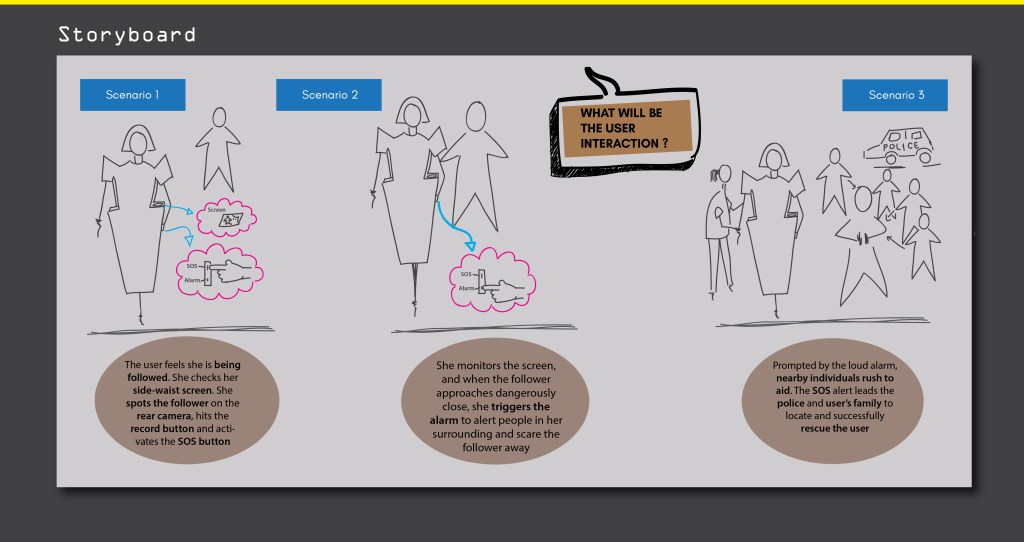
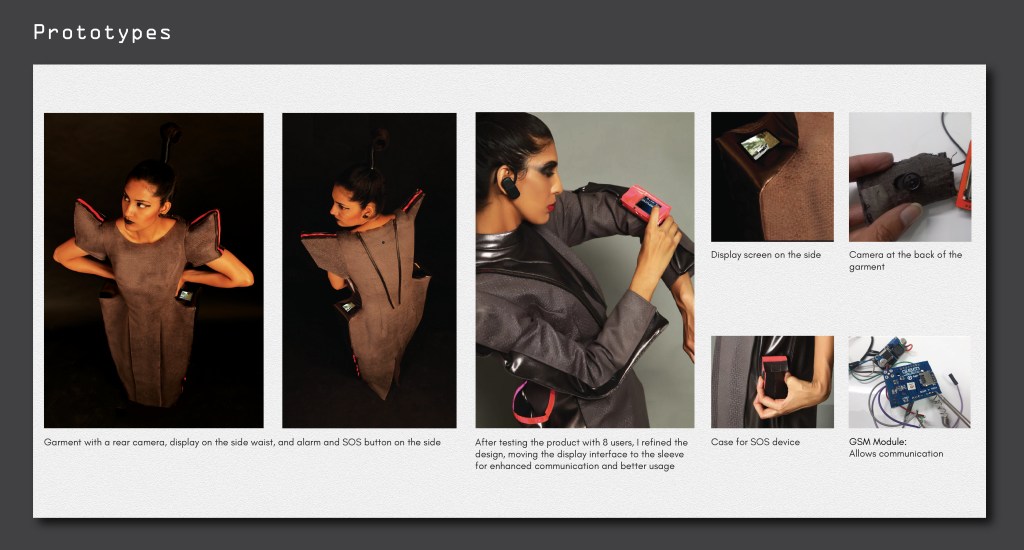
I was invited by various organizations like Arduino India, Maker Faire Berlin, Re:publica, Berlin, Deutsche Gesellschaft für Internationale Zusammenarbeit (GIZ), Distributed Design Platform, and We Make the City, etc., to present my project and share my insights on the issue of women’s safety.
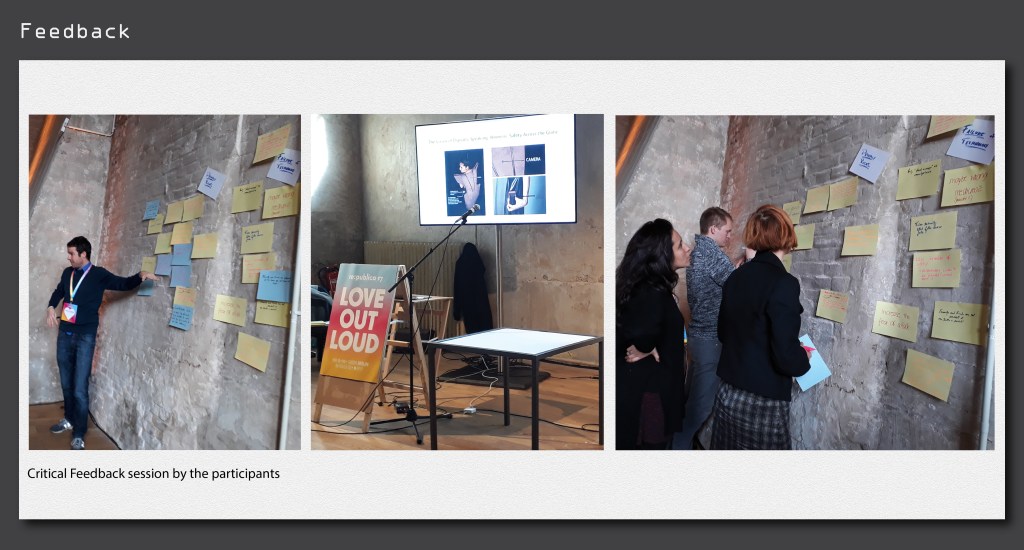
Invited to discuss “Fashion Tech and Privacy-by-Design ” in a panel with professors from the Alexander von Humboldt Institute for Internet and Society (HIIG) in Berlin. Upon engaging in discussions with participants and professors, I identified design flaws and due to privacy concerns, removed camera and screen, then redesigned the garment.
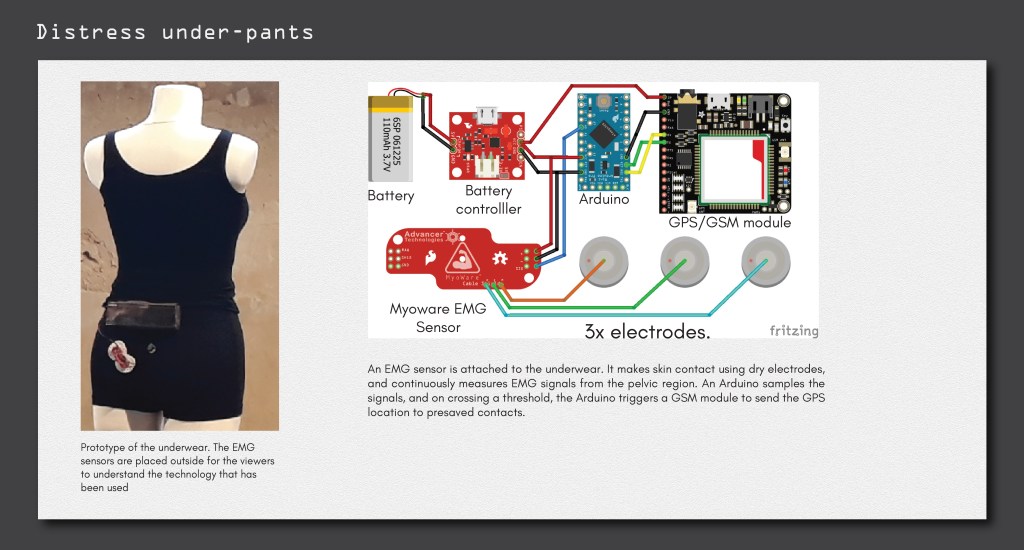
The updated designs ensures distress activation without manual input, ensuring usability in situations where physical interaction is unfeasible. The solution involved using muscle movement to trigger an alarm. After testing with EMG sensors, pelvic muscles proved effective. Underpants were used to incorporate this idea. Users can discreetly activate emergency alerts, sending distress messages with GPS location.
Next Steps: The next steps for this project would involve collaborating with a research lab to enhance the technology, ensuring it can function effectively in low or no GPS environments while still transmitting the user’s location. This would likely include exploring the use of mesh networks or LiDAR data, and determining how to make the wearable underwear both unobtrusive and seamless.

 nidhimittal.in